
Marina Brucet holds a BA and a MA in Biochemistry and a PhD in Molecular Biology in Immunology from the University of Barcelona, where she also performed postdoctoral studies. After this, she decided to change research in the laboratory for research of the mind and its possibilities. To this aim, she completed a six-year full-time study program Masters Program of Advanced Buddhist Studies of Sutra and Tantra at Lama Tzong Khapa Institute, Italy. She studied with great Tibetan lamas such as His Holiness the Dalai Lama, Lama Zopa Rinpoche, Lama Jampa Monlam and Khensur Jampa Tegchok, amongst others, and has completed a one-year individual meditation retreat, among others. Presently, she combines continual development and meditation retreats with teaching meditation and Buddhist philosophy, at both general and specialized levels, with an approach that always takes into account the context and circumstances of Western life. She mainly teaches at Tushita Meditation Center Spain and other FPMT centers, and collaborates with SEE Learning (Emory University) in Spain.

Hans Burghardt holds a BA and a MA in Biochemistry and Molecular Biology and a PhD from the University of Barcelona, where he spent seven years doing research. Since 2002, he meditates and is a student of great Buddhist masters including His Holiness the Dalai Lama, Kyabje Lama Zopa Rinpoche, Kirti Tsenshab Rinpoche, Lama Jampa Monlam, Khensur Jampa Tegchok amongst others. He has completed the Masters Program of Advanced Buddhist Studies of Sutra and Tantra at Istituto Lama Tzong Khapa (Italy) and has completed a one-year individual meditation retreat. He currently teaches meditation and Buddhism at Tushita Meditation Center Spain and other FPMT centers, and is co-founder and coordinator of the Initiative for an Emotional, Ethical, and Social Education, that promotes the establishment of Emory University’s SEE Learning in Spain.

Ven. Charles Trébaol has been completing, for the last four years, a round of 108 Nung nays at the Vajrayogini Institut in France. He is, therefore, a unique guide to this practice.
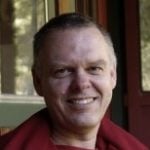
Ordained by the Dalai Lama more than thirty years ago, Swiss monk Ven. René Feusi has studied with some of the greatest scholars and inspiring lamas in the Tibetan diaspora. He has also performed numerous extensive retreats, including a two-and-a-half-year seclusion focused on developing mental stability. He has led large Buddhist events in Europe, Asia, and North America, and he has students worldwide. The resident teacher at Vajrapani Institute in the Santa Cruz mountains from 2001 to 2007, he now splits his time equally between teaching and retreat. He lives in Tonasket, WA. He has recently published The Beautiful Way of Life: A Meditation on Shantideva’s Bodhisattva Path.

Originally from California, Ven. Sangye Khadro (Kathleen McDonald) began studying Buddhism with Tibetan lamas in Dharamsala, India, in 1973. She became a nun in Nepal the following year, and received full (bhikshuni) ordination in 1988. At the request of her teachers, she began teaching in 1980, and since then has been teaching Buddhism and meditation in various countries around the world, occasionally taking time off for personal retreats. She is a graduate of the Masters Program in Buddhist Studies in Sutra and Tantra, which she followed at Lama Tsong Khapa Institute in Italy from 2008-2015. Ven. Sangye Khadro is the author of the bestselling book How To Meditate, among others.